Community Remembrance Projects provide a way for PGC LMP to remember and honor those who were lynched in Prince George’s County. Learn more about them here, why they are important and how you can get involved.
What are Community Remembrance Projects?
Community Remembrance Projects are created by community members to publicly acknowledge and memorialize victims who were lynched within a community. Projects involve community participation in research, education, memorials, and conversation about the truth of racial injustice and racial terror lynching.
Why are Community Remembrance Projects important?
“We cannot heal the deep wounds inflicted during the era of racial terrorism until we tell the truth about it.”
– Bryan Stevenson, Founder and Executive Director, Equal Justice Initiative
Community Remembrance Projects serve to tell the truth about the history of racial terror lynchings, to honor and memorialize victims whose lives were lost, and to promote restorative justice, racial equity, reconciliation and healing. The Equal Justice Initiative (EJI), a national nonprofit legal and civil rights group based in Montgomery, Alabama, supports local communities in developing Community Remembrance Projects.
What do Community Remembrance Projects include?
Community Remembrance Projects vary in approaches, but usually include these components:
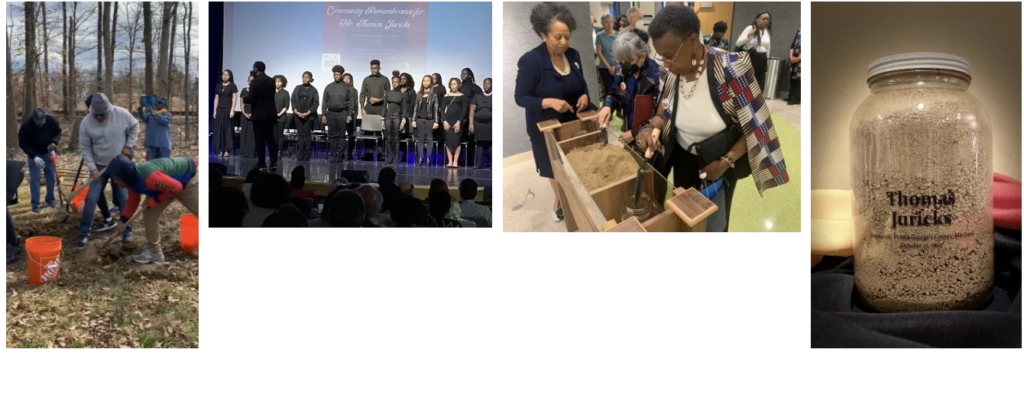
- Soil Collection Ceremonies. Soil is collected by community members with a ceremony at the site of a lynching, as a tangible opportunity to acknowledge the history of the lynching. The soil is later cleaned and placed into memorial glass jars labeled with the victim’s name for preservation. The jars of soil are displayed in museums, including the EJI Legacy Museum in Montgomery, Alabama and the Reginald F. Lewis Museum in Baltimore, Maryland, and at local community educational or memorial events.
- Remembrance Ceremonies. A ceremony to gather people in the community to celebrate the life of a victim of lynching, offering dignity and respect to the victim. May include community speakers and musical presentations. Attendees may place collected and cleaned soil in memorial jars. Ceremonies serve to educate the attendees and promote community healing.
- Historical Marker Placements. Narrative historical markers are placed with a ceremony at a site relevant to the lynching to create a permanent public record of racial terror violence.
How does the Prince George’s County Lynching Memorial Project (PGCLMP) work with the community in creating projects?
Thirty-eight documented lynchings occurred in Maryland.
Four took place in Prince George’s County: Thomas Juricks (1869 – Piscataway), John Henry Scott (1875 – Oxon Hill), Michael Green (1878, Upper Marlboro), and Stephen Williams (1894 – Upper Marlboro).
Inspired and supported by the work of the Equal Justice Initiative, the Prince George’s County Lynching Memorial Project (PGCLMP), a partner with the Maryland Lynching Memorial Project, is a volunteer inclusive community organization that aims to fully involve the community in remembrance projects. PGCLMP works within the community to research the background of victims, their families, and the lynching incident, including personal community connections to the legacy of racial injustice and trauma. PGCLMP conducts community education presentations about the victims and lynching. PGCLMP planned and conducted a remembrance project for Mr. Thomas Juricks with wide community input.
How can I support Community Remembrance Projects?
- Learn about the truths of our nation’s continuing legacy of racial terror.
- Learn about the history of lynchings in Prince George’s County.
- Attend community education and remembrance events sponsored by PGCLMP.
- Help research lynchings that occurred in Prince George’s County.
- Help plan and prepare for a Community Remembrance Project.
- Learn about the work of the Maryland Truth and Reconciliation Commission.
- Share this information to advance the cause of truth and reconciliation.
- Join the PGCLMP to educate, memorialize, and advance the cause of racial justice and reconciliation and to honor victims of lynchings in Prince George’s County
Where can I learn more?
- Community Remembrance for Mr. Thomas Juricks | (April 15, 2023) (full ceremony)
- Equal Justice Initiative | Documentation, stories, and videos about the truths of our nation’s continuing legacy of racial terror
- Equal Justice Initiative. Community Remembrance Project
- Honoring Mr. Thomas Juricks: Lynched in Piscataway, MD | (visual summary of ceremony)
- Maryland Lynching Memorial Project
- Maryland Lynching Truth and Reconciliation Commission
- Prince George’s Remembers the County’s First Known Lynching Victim | Washington Post, April 15, 2023
- Reginald F. Lewis Museum of Maryland African American History & Culture